
Your spine is built to move, and most of us spend the day politely asking it not to. A long commute, eight hours at a desk, an evening folded into the sofa — the pattern adds up as a stiff upper back, tight hips and shoulders that creep forward. Yoga is one of the most useful ways to reverse that drift, because it takes the spine through flexion, extension, rotation and length while you breathe. You do not need to be flexible to begin. What follows is a straightforward sequence you can do at home in about fifteen minutes.
What yoga does for your spine
The discs between your vertebrae have a limited blood supply. They rely on movement and changes of load to stay hydrated and healthy, which is one reason a day of stillness leaves you feeling creaky by six o'clock. Yoga provides that movement in a controlled way, and it also trains the muscles around the spine — the deep abdominals, the glutes, the muscles between the shoulder blades — to hold you upright for longer.
What yoga will not do is fix a structural problem, and no single pose will "correct" your posture for good. Posture is not one perfect shape; it is the ability to change position often and to hold a comfortable position without effort. Keep that in mind and you will get far more from your mat.
Before you start
- Aim for fifteen minutes, four or five days a week. Short and regular beats one long session on Sunday.
- Use a non-slip mat, and keep a blanket and two cushions nearby for padding.
- Move into each pose as you breathe out, then stay for three to five slow breaths.
- Expect a mild stretch. Sharp pain, pinching or tingling means back off or stop.
- If you have a diagnosed spinal condition, a recent injury or surgery, or you feel numbness or weakness in an arm or leg, speak to your GP or a physiotherapist first.
The 10-pose beginner sequence
Work through these in order. The first three warm you up, the middle four mobilise, and the last three let everything settle.
1. Mountain pose (Tadasana)
Stand with feet hip-width apart, weight even across both feet. Let your arms rest by your sides and lift gently through the crown of your head, chin level. Take five breaths here. This is your reference point: notice where you hold tension before you move.
2. Cat–Cow
Come onto hands and knees, wrists under shoulders, knees under hips. Breathe in and drop the belly, lifting chest and tailbone. Breathe out and round the spine, tucking the chin. Move slowly for eight to ten rounds. This is the warm-up your back actually wants.
3. Child's pose (Balasana)
Take the knees wide, big toes together, and sit the hips back towards the heels. Walk the hands forward and rest your forehead on the mat or a cushion. Stay for five to eight breaths. If your knees complain, place a folded blanket behind them or sit on a cushion.
4. Thread the needle
From all fours, slide the right arm underneath the left, letting the right shoulder and ear come towards the mat. The left hand can stay forward or rest behind your back. Hold for five breaths, then swap sides. This targets the mid-back, the area that stiffens first at a desk.
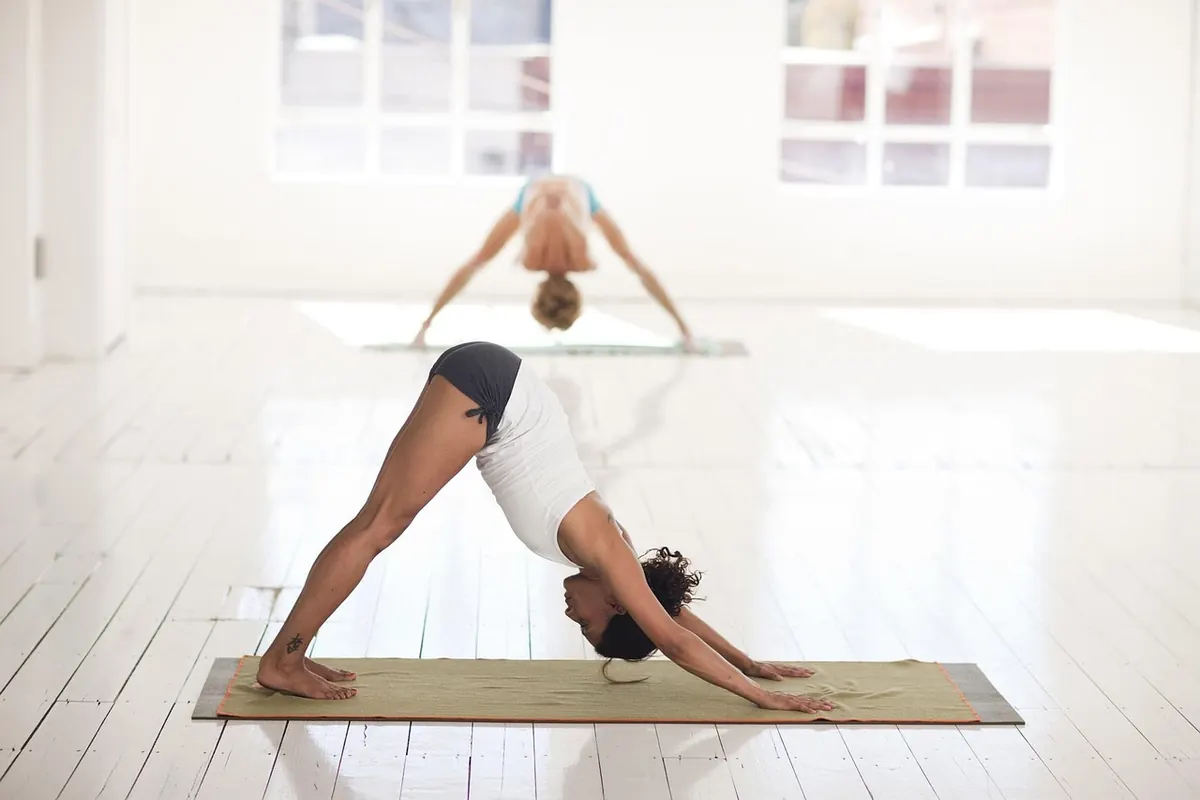
5. Downward-facing dog
From all fours, tuck your toes and lift the hips up and back. Bend your knees generously — a long spine matters far more than straight legs. Press through the hands and let the head hang. Five breaths, then lower the knees. Come into child's pose in between if you need to.
6. Standing side bend
Stand tall, feet hip-width. Breathe in and reach the left arm overhead, breathe out and lean to the right, keeping both feet grounded and the ribs from flaring. Three to five breaths, then change sides. A useful antidote to a day of sitting.
7. Low lunge with a twist
Step the right foot forward between the hands and lower the left knee, padding it with a blanket. Lift the torso and bring the hands to the heart, then twist to the right: right hand to the left thigh, left hand behind you. Keep the hips level. Five breaths, then swap.
8. Sphinx
Lie on your front with the forearms on the mat, elbows under the shoulders and legs hip-width. Press the forearms down and lift the chest a little, keeping the neck long and the lower back easy. Five breaths. A gentle backbend that counters all that rounding forward.
9. Supine twist
Lie on your back with the arms out to the sides and knees bent. Let the knees fall to the right and turn the head to the left. If the lower back feels pinched, rest the knees on a cushion. Stay for eight to ten breaths, then change sides.
10. Legs up the wall
Sit sideways next to a wall, then swing the legs up and lie back, shuffling close enough for comfort. A folded blanket under the hips is optional. Let the arms rest open. Stay for three to five minutes and let the whole back settle into the floor.
Putting it together
If you have fifteen minutes, split it into three blocks of five:
- Wake up: cat–cow, thread the needle, child's pose.
- Lengthen: downward-facing dog, standing side bend, low lunge with a twist.
- Settle: sphinx, supine twist, legs up the wall.
On a busy day, do just three: cat–cow, thread the needle and the supine twist. That still counts.
Making it stick
Attach the sequence to something you already do — after your morning coffee, or before your shower. Leave the mat out so it is the first thing you see. Progress usually shows up in small ways rather than dramatic ones: turning your head more easily when reversing the car, sitting taller without thinking about it, fewer aches after a long drive. Give it a few weeks of regular, unhurried practice before you judge it.
When to pause and ask for help
Yoga sits alongside good treatment, not instead of it. If you have osteoporosis, a disc problem, a recent fracture or surgery, or you notice pain shooting down an arm or leg, get the all-clear from a GP or physiotherapist before you start, and ideally work with a qualified yoga teacher who knows your history. Stop if a pose makes symptoms worse, and never push through pain to chase a shape.
Photo: AndiP / Pixabay